Dentists are increasingly told that building online visibility requires becoming a content creator. Record videos about treatments. Share personal stories. Post regularly on social media. Become the recognizable face of the practice.
That strategy can work for dentists who are comfortable on camera, but it is not a requirement for appearing in Google, local search results, or AI-generated answers.
Some dentists prefer to keep their personal and professional lives separate. Others do not have time to plan, record, edit, and distribute a continuous stream of content. Multi-dentist practices may also be reluctant to build their marketing around one practitioner whose role could eventually change.
More importantly, the way patients search is evolving. People still use Google to find a nearby dentist, but they are also asking ChatGPT, Google’s AI-powered search features, and other generative platforms questions about symptoms, treatments, costs, recovery, and local providers.
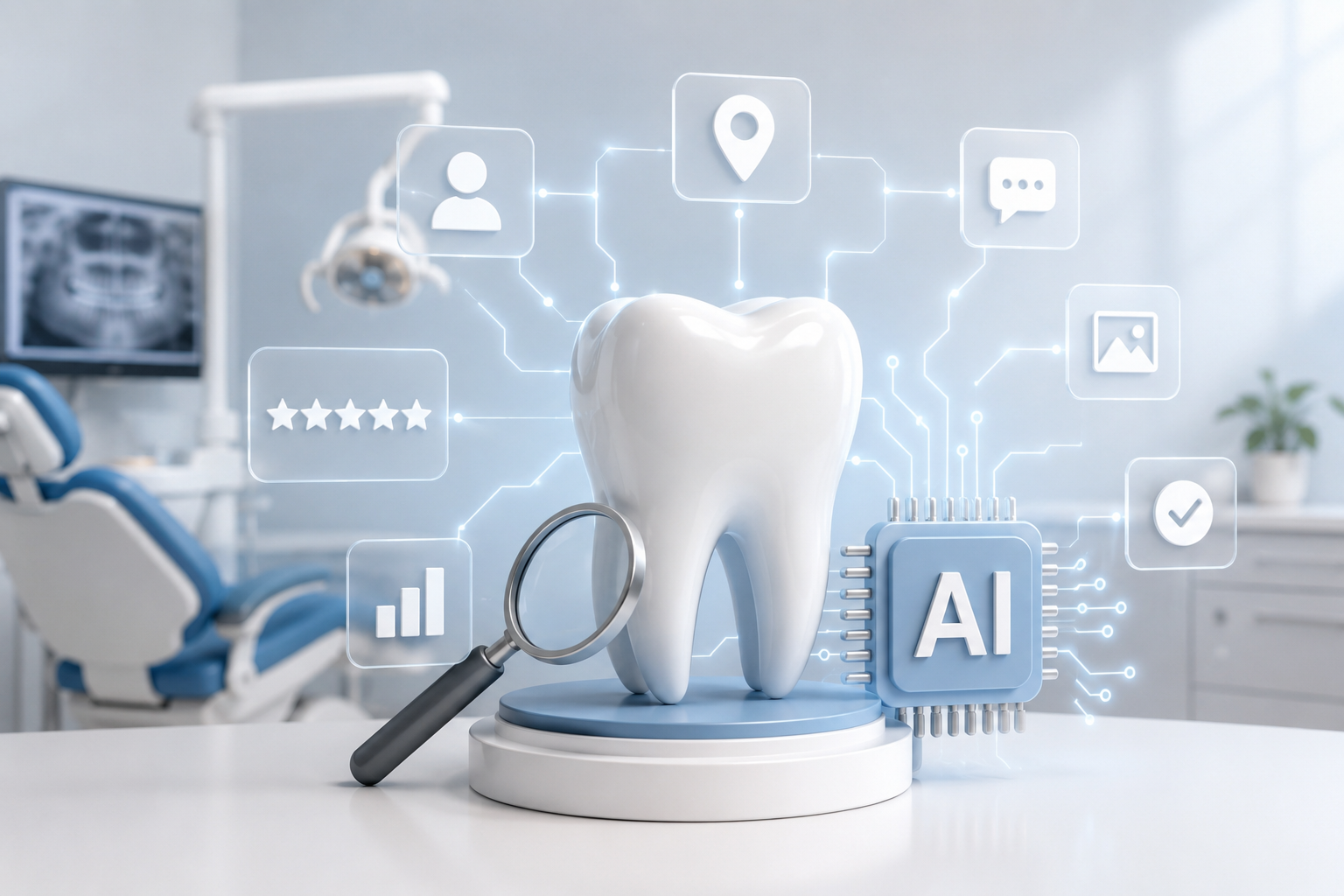
This is where Generative Engine Optimization becomes increasingly relevant. GEO helps make a practice’s information easier for AI systems to retrieve, interpret, summarize, and potentially reference. SEO helps search engines crawl, index, understand, and rank the same information in traditional search results.
Neither requires the dentist to become an influencer.
A future-proof GEO and SEO strategy can be built around the practice itself: its website, clinical knowledge, local presence, patient reviews, professional credentials, structured data, and technical accessibility.
The dentist does not need to become the product. The practice can become the trusted source.
Personal Visibility Is Different From Search Visibility
Personal branding is designed to make an individual recognizable. GEO and SEO visibility are designed to make information discoverable and understandable.
There can be overlap, but these are not the same objective.
A dentist may have thousands of social media followers while remaining absent from searches such as “emergency dentist near me,” “dental implants in Toronto,” or “children’s dentist accepting new patients.” That dentist may also be missing when someone asks an AI platform to identify local clinics providing those services.
Another practice may rarely publish on social media but perform well because it has comprehensive service pages, accurate local information, current reviews, strong internal linking, and a technically accessible website.
Search systems are trying to resolve several fundamental questions. They need to understand the identity of the practice, its physical location, the communities it serves, the treatments it provides, the professionals working there, and which pages offer useful answers to specific patient questions.
Generative systems introduce an additional challenge. Content must be clear and well structured enough to be extracted and summarized without losing its meaning.
A generic statement promising “high-quality dentistry for the whole family” provides very little usable information. A page that explains treatment candidacy, symptoms, diagnostic steps, alternatives, recovery, and appointment availability gives both patients and search systems substantially more context.
Make the Website the Practice’s Primary Knowledge Base
A future-proof dental website should do more than display a list of treatments. It should function as a structured knowledge base that explains the clinical problems the practice addresses and the care it provides.
Each important treatment should generally have a dedicated, indexable page. Combining root canals, crowns, implants, extractions, emergency care, and children’s dentistry into one short services page limits the information search systems can associate with each treatment.
A root canal page, for example, should explain why treatment may be recommended, which symptoms can indicate an infected pulp, how the condition is diagnosed, what happens during the procedure, whether sedation is available, and when a crown may be needed afterward.
An emergency dentistry page should answer immediate questions about knocked-out teeth, facial swelling, severe pain, uncontrolled bleeding, fractured teeth, and broken restorations. It should also explain whether the practice reserves time for same-day appointments and how patients can request urgent care.
This type of question-led content reflects how people search. It also produces focused passages that AI systems can interpret and potentially use when constructing an answer.
The technical structure of the page is equally important. Every major page should have a descriptive title, one clear primary heading, logically nested subheadings, readable HTML text, descriptive internal links, accessible images, and a suitable canonical URL.
Important information should not exist only inside an image, video, downloadable PDF, or interactive element that may not be reliably rendered. Search systems cannot use information they cannot consistently access.
The objective is not to repeat a target keyword throughout the page. It is to create the clearest and most useful response to the patient’s underlying question.
Capture Clinical Expertise Without Creating Another Job
Dentists do not need to personally write every article or record weekly videos to contribute meaningful expertise.
A more efficient editorial process can collect knowledge through short interviews, voice notes, questionnaires, existing patient handouts, or written answers to common questions. A writer or marketing partner can then develop that material into service pages, articles, FAQs, newsletters, and patient guides.
The dentist’s role is to provide clinical accuracy, practical context, appropriate cautions, and first-hand observations. The marketing team can manage search research, writing, page structure, editing, metadata, internal linking, and publication.
This process usually produces better content than asking a dentist to start with a blank page. It also reduces the risk of publishing generic material that sounds polished but does not reflect the clinic’s actual experience.
A dentist may know that patients often misunderstand the difference between a filling and a crown, postpone treatment because a fractured tooth is not painful, or assume that bleeding gums are normal. These observations can become original and useful content without requiring the dentist to appear on camera.
Authorship and clinical review should still be transparent. An article can identify its writer, name the dentist who reviewed it, display relevant qualifications, link to a professional biography, and show when the information was last reviewed.
This creates accountability without forcing the dentist to become a public personality.
Build Topical Authority Around the Practice
A practice can demonstrate authority by developing connected resources around the services it actually provides.
A dental implant page might be supported by articles about candidacy, bone grafting, treatment timelines, implant maintenance, smoking risks, and the differences between implants and bridges. Internal links help patients move through those resources while showing search systems how the subjects are related.
This hub-and-supporting-content approach is more strategic than publishing unrelated articles simply to keep the blog active. It builds depth around the treatments the practice wants to be known for.
It also creates a more durable business asset. If the clinic’s authority depends entirely on one dentist’s social media profile, much of that visibility can leave with the individual. When expertise is built into the website, local presence, and content library, it remains connected to the practice.
Publishing frequency matters less than usefulness, accuracy, and subject coverage. One thoroughly researched resource can provide more long-term value than several short articles that repeat information already available elsewhere.
Strengthen Local Relevance and Entity Consistency
Dental care remains highly local. A patient may begin by researching symptoms or treatment options, but the final decision usually involves finding a clinic that is nearby, available, and able to provide the required care.
The Google Business Profile should accurately represent the practice’s real-world operations. Its categories, address, telephone number, hours, appointment link, services, and photographs should agree with the information on the website.
Consistency extends beyond the name, address, and phone number. Search systems should encounter a stable description of the practice, its location, its practitioners, and its services across maps platforms, dental directories, professional profiles, and relevant local references.
The website should reinforce these relationships with a detailed contact page, current office hours, directions, parking or transit information, accessibility details, and clearly identified service areas.
Location pages may help a clinic demonstrate relevance to nearby communities, but each page should offer genuine local information. Simply copying the same text and replacing the city name creates little value and may cause several pages to compete for the same search intent.
A practice with one physical office should also avoid implying that it operates locations in communities where it has no clinic. Clear geographic information helps both patients and search systems understand the practice accurately.
The goal is to establish a coherent local entity rather than produce a collection of interchangeable location pages.
Let Reviews and Visual Content Build Familiarity
Personal branding often works because patients want to know what interacting with a professional will feel like. Reviews can provide that reassurance without requiring the dentist to make repeated claims on camera.
Patients may describe how the team responded to an emergency, helped a nervous child, explained treatment costs, accommodated mobility needs, or made a complicated procedure feel manageable.
These descriptions provide independent evidence of the patient experience. They may also naturally mention treatments, neighbourhoods, languages, accessibility, or team members, adding useful context around the practice.
Reviews should always be requested ethically. Patients should be invited to provide honest feedback without incentives, pressure, or scripts designed to manufacture specific language. Responses should remain professional and must not disclose private clinical information.
Visual marketing can also support familiarity without turning one dentist into the centre of the brand.
Professional photography can show the exterior, reception area, treatment rooms, technology, accessibility features, and team environment. Custom diagrams, animations, narrated presentations, and consent-based before-and-after images can help explain treatments.
Those assets should be optimized technically. Images need appropriate dimensions, compression, descriptive filenames, and useful alternative text. Videos should include captions, transcripts, descriptive titles, and supporting page content. This makes the information more accessible to patients and easier for search systems to interpret.
Create a Consistent Practice Voice
When marketing is not centred on one public personality, the practice’s editorial voice becomes especially important.
Website pages, emails, review responses, articles, social posts, and patient resources should sound as though they come from the same organization. For most dental clinics, that voice should be calm, specific, professional, and reassuring.
Clinical terminology should be explained when it is necessary and replaced with plain language when it is not. Questions about discomfort, recovery, risks, costs, and treatment alternatives should be answered directly without exaggerated promises.
AI tools may assist with research, outlining, or editing, but unreviewed output can introduce factual errors, repetitive phrasing, invented details, or claims that do not reflect the clinic’s actual services.
Every page should therefore be checked for clinical accuracy, originality, local accuracy, links, dates, tone, and consistency with the practice’s real policies.
Use Structured Data to Clarify the Practice
Structured data helps search engines interpret the information on a dental website more accurately. It can reinforce the relationship between the practice, its location, its services, its articles, and the professionals responsible for reviewing the content.
For a dental clinic, the right implementation may support business information, professional credentials, service details, publication content, navigation, hours, and contact information. The exact setup depends on the structure of the website and the types of pages being optimized.
Structured data is not a shortcut to rankings, and adding more markup does not automatically create better visibility. It needs to reflect information that is already accurate and visible on the website. It also needs to be implemented in a way that supports the broader GEO and SEO strategy rather than operating as a disconnected technical exercise.
When used properly, structured data gives search engines a clearer framework for understanding the practice. When used poorly, it can create inconsistencies or add complexity without improving performance.
A professional technical review can determine which markup is appropriate, where it should be used, and whether the current setup is helping or creating confusion.
The same applies to broader technical performance. Clear headings, crawlable navigation, accessible text, functioning internal links, fast loading times, XML sitemaps, canonical URLs, and indexable service pages all help search systems access and interpret the practice’s information.
A dental website may use Dentist or another appropriate LocalBusiness subtype for the practice, Person for practitioner profiles, and Article for educational resources.. Stable identifiers can connect related entities where appropriate.
The markup must describe information that is already visible on the page. Passing a structured-data validation test does not guarantee a rich result, an AI citation, or a higher ranking.
Future-Proof the Practice, Not the Personality
Appearing on camera may help some dentists create familiarity, but it is not a requirement for GEO and SEO success.
Search interfaces will continue to change. The durable assets are the practice’s clinical knowledge, local relevance, technical accessibility, reputation, and ability to answer patient questions clearly.
A dental practice can build authority through comprehensive service pages, original educational content, transparent clinical review, accurate local information, ethical reviews, optimized visual assets, structured data, and a technically sound website.
The strategic question is not whether the dentist will be visible. It is where the practice’s authority will live.
For many dentists, the strongest long-term answer is the practice itself.
Contact clickguru for a free website audit and a practical review of your content, local presence, structured data, technical performance, and GEO and SEO opportunities.
Do dentists need to appear on video for GEO and SEO?
No. Video can help establish familiarity, but it is not required for GEO and SEO success. Dental practices can build visibility through detailed service pages, educational content, patient reviews, accurate local information, structured data, and a technically accessible website.
What is the difference between GEO and SEO for dental practices?
GEO helps make a dental practice’s information easier for AI-powered platforms to retrieve, interpret, and reference in generated answers. SEO helps search engines crawl, index, understand, and rank the practice’s pages in traditional search results. The two strategies should work together.
What type of dental content supports AI search visibility?
Content that directly answers patient questions is especially valuable. Strong pages explain symptoms, treatment candidacy, diagnostic steps, procedures, recovery, risks, alternatives, and when to contact a dentist. The information should be original, clinically reviewed, clearly structured, and easy to access.
Does structured data improve dental search rankings?
Structured data does not automatically improve rankings. It helps search engines interpret relationships between the dental practice, its location, practitioners, services, and articles. The markup must accurately reflect information that is visible on the website.
How can a dental practice future-proof its GEO and SEO strategy?
A dental practice should invest in comprehensive service pages, original educational resources, accurate local listings, genuine patient reviews, structured data, internal linking, mobile performance, and technical accessibility. These assets remain valuable as traditional and AI-powered search interfaces evolve.