It’s easy to feel whiplash when you follow search-engine news: AI overviews, shifting algorithms, rising zero-click results—the ground seems to move daily. Yet amid all the noise, clear patterns are emerging. Below are five SEO trends we’re betting on for 2025 and beyond, complete with real-world examples and practical takeaways you can apply today.
5 SEO Trends You Can’t Ignore
1. Laser-Focused Search Intent Is the New Baseline
Search intent has always mattered, but Google is now narrowing acceptable intent matches. Where a comprehensive “ultimate guide” once ranked for dozens of mid-funnel keywords, the top results are being consolidated around pages that perfectly satisfy a single intent.

Evidence
-
“Keyword research” SERP shift:
-
April 2024: 50 % of top-10 results were keyword-research tools; the rest were guides or listicles.
-
April 2025: 80 % of top-10 results are live, usable tools.
-
-
“QR code scanner” query: The #1 page is literally just a functioning scanner—zero text, zero fluff.
What This Means for You
-
Audit every target keyword. Identify the dominant intent (information, comparison, transaction, tool, etc.).
-
Create or refine one asset per intent. Don’t shoehorn multiple purposes into a single page.
-
Use engagement metrics (bounce rate, dwell time) to validate you truly solved the searcher’s problem.
Takeaway: Rank potential tanks when intent mismatch exists. Start every content brief with “exactly what will the searcher expect to do on this page?”
2. AI Is Reshaping—Not Replacing—Content Creation
Generative AI exploded in 2024, and by 2025 it’s table stakes. But the winners aren’t auto-publishing ChatGPT drafts; they’re augmenting expert writers.

Smart Uses of AI
-
First-pass outlines & summaries: Quickly structure articles or condense research.
-
Data formatting: Turn spreadsheets into ready-to-embed tables and charts.
-
Gap analysis: Ask AI to compare your draft against top SERP results and flag missing subtopics.
What Still Requires Humans
-
First-hand expertise & E-E-A-T. Google’s leaked “OriginalContentScore” API field confirms novelty matters.
-
Unique angles & fresh data. Interviews, proprietary stats, and case studies remain unbeatable.
-
Brand voice & compliance. AI can mimic tone, but only you know the legal/regulatory nuances of your industry.
Takeaway: Position writers as content curators. Let AI handle busywork while humans inject insight. That balance will define “top-tier content” in the post-ChatGPT era.
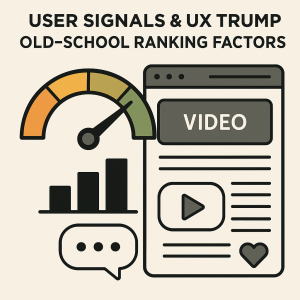
3. User Signals & UX Trump Old-School Ranking Factors
In testimony from Google’s 2023 antitrust case, internal patents revealed heavy reliance on behavioral signals—click-through rate, dwell time, pogo-sticking—to judge quality. Core Web Vitals updates further tie technical UX to rankings.
How to Optimize for User Signals
| UX Element | SEO Impact | Quick Win |
|---|---|---|
| Page speed (LCP < 2.5 s) | Higher engagement, lower bounce | Compress images; enable lazy-loading |
| Clear information hierarchy | Better dwell time | Use descriptive H2/H3s; add jump links |
| Interactive elements | Longer session duration | Embed calculators, checklists, or mini tools |
| Mobile-first layout | Better rankings on majority of searches | Test in Google’s Mobile-Friendly Tool |
Example
A dental clinic replaced a 1 000-word “teeth whitening” wall of text with:
-
200-word intro answering the core question in 30 seconds
-
A cost calculator widget
-
Before-and-after slider images
Result: time on page up 68 %, organic leads up 42 % in three months.
Takeaway: Google proxies user happiness through engagement metrics—design pages that make people stay, scroll, click, and share.
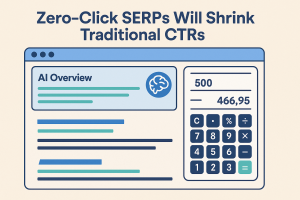
4. Zero-Click SERPs Will Shrink Traditional CTRs
Featured snippets, People-Also-Ask, and AI Overviews (AIO) are siphoning clicks. Early studies show informational queries with AIOs see 18–64 % lower organic CTR.
Surviving (and Thriving) in Zero-Click Land
-
Chase citations, not just positions. AIO pullouts often include 8-12 source links—and only ~25 % overlap with the traditional top-10. Even smaller sites can earn those spots with authoritative, well-structured answers.
-
Own branded SERPs. When generic clicks drop, branded searches (e.g., “ClickGuru audit”) become vital. Maintain reputation, reviews, and social proof to command those results.
-
Provide irresistible reason to click. Offer free tools, templates, or interactive demos that no SERP summary can replicate.
Example
A SaaS firm injected a live “ROI calculator” above the fold on its cornerstone guide. Despite AIO appearing, the page’s CTR held steady because users had to click to use the tool.
Takeaway: Assume some queries will never deliver the clicks they once did. Strategize for secondary SERP real estate and unmatched on-site value.
5. User-Generated & Community Content Gains Algorithmic Favor
Google’s 2024 Helpful Content and subsequent core updates elevated first-hand experience—hence Reddit and Quora traffic spikes (Reddit’s organic visits up 600 % YoY). As AI-generated copy proliferates, authentic voices stand out.

Action Plan
-
Mine in-house expertise. Turn dentist Q&A transcripts or technician field notes into blog posts.
-
Foster on-site community. Allow comments, ratings, or case-study submissions; mark them up with Schema “FAQ” or “DiscussionForumPosting.”
-
Participate in external forums where prospects seek advice; your insights can rank independently and funnel referral traffic.
Takeaway: Original perspectives—patient stories, technician tips, founder diaries—send strong trust signals. Lean into them to future-proof rankings.
Putting It All Together
| Trend | Why It Matters | First Step to Implement |
|---|---|---|
| Matching intent | Google tightens relevance | Re-map top 50 keywords to single intents |
| AI-augmented content | Efficiency without quality loss | Pilot AI summaries + expert expansion |
| UX & user signals | Direct ranking factor | Run Core Web Vitals audit; fix red flags |
| Zero-click survival | CTRs dropping | Create click-worthy tools & chase AIO citations |
| Community/UGC | Authenticity beats AI fluff | Collect and publish first-hand stories |
Frequently Asked Questions
Q1. Will AI overviews kill organic traffic?
No—but they’ll redistribute it. Expect fewer clicks on simple info queries and more competition for cited sources and interactive content.
Q2. How do I find true search intent?
Analyze the current top five results: Are they guides, tools, products? Mirror that format, then add superior value.
Q3. Does schema markup still matter in 2025?
Absolutely. Structured data helps Google parse facts for AIO and rich results—FAQ, How-To, Product, and LocalBusiness schemas are must-haves.
Q4. Are backlinks less important now?
Quality links remain a core authority signal, but thin content with strong backlinks won’t outrank intent-matched, UX-optimized pages.
Q5. What KPIs should I track for these trends?
Monitor organic sessions, click-through rate, dwell time, Core Web Vitals, and new AIO citation count to gauge adaptation success.
Ready to Future-Proof Your SEO?
Staying ahead of these trends demands time, expertise, and constant experimentation—resources many teams lack. clickguru specializes in results-driven SEO that aligns perfectly with 2025’s landscape: laser-focused intent mapping, AI-augmented content, UX overhauls, and zero-click mitigation.
Book a free website audit today and see exactly where you can capitalize on the next wave of search evolution. Your future rankings (and revenue) will thank you.